Pavers in South Florida: The Complete Homeowner's Guide
A homeowner's guide to paver driveways, patios, and pool decks in South Florida: choosing materials, colors, and patterns, what makes an installation last, and how to care for it.
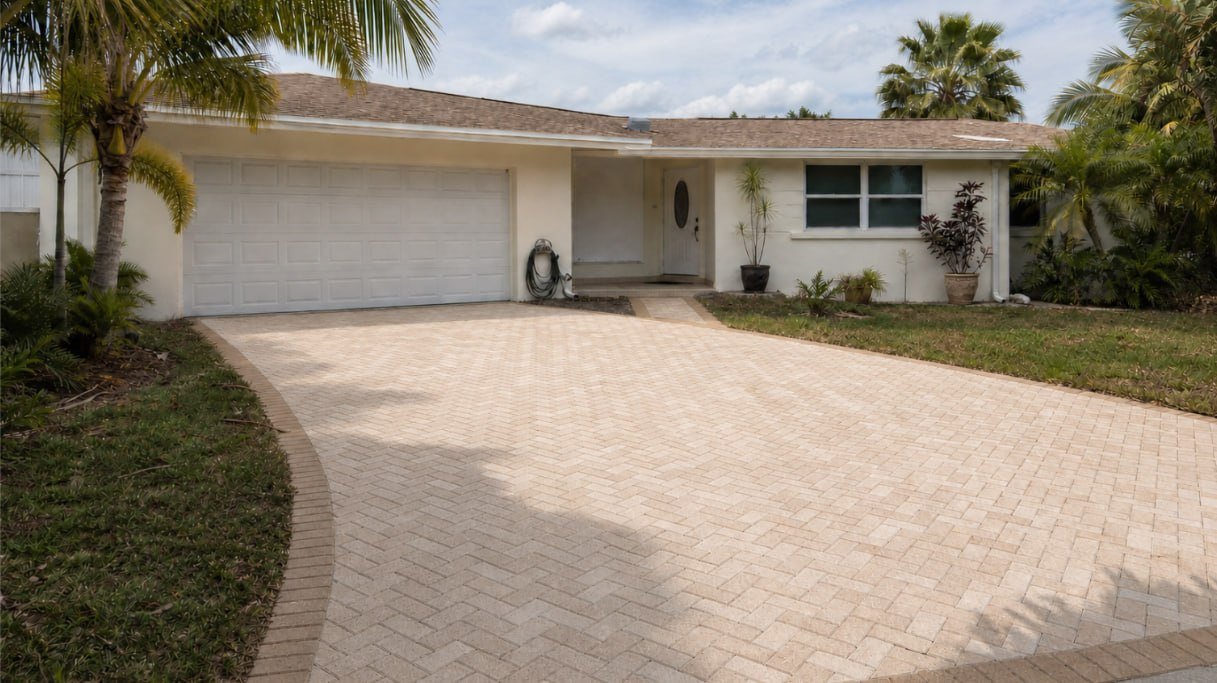
A well-built paver surface is one of the few home improvements that looks better in person than it does on paper, and one of the fewer still that keeps performing for decades in a climate as demanding as ours. If you are considering pavers for a driveway, a patio, or the deck around your pool, this guide is the place to start. It gathers everything a South Florida homeowner should understand before beginning, from choosing a material to caring for the finished surface, and points you toward deeper reading on each topic along the way.
Why pavers make sense in South Florida
Our climate is beautiful and unforgiving in equal measure. Intense sun, heavy seasonal rain, high humidity, and coastal salt air put every outdoor surface to the test, and poured concrete rarely passes it. Slabs crack as the ground shifts, stain permanently, and can only be patched in ways that never quite disappear.
Pavers behave differently. Because a paver surface is made of many individual units set over a flexible base, it moves with the ground instead of fighting it, which is why it resists the cracking that plagues concrete here. A single stained or damaged paver can be lifted and replaced with no visible patch. For a fuller comparison of the two surfaces in our conditions, our guide on pavers versus concrete in South Florida walks through the differences in detail.
Where pavers go: the main applications
Almost any outdoor surface around a home is a candidate for pavers, and each has its own considerations.
A paver driveway is the first thing you and your guests see, and it carries the heaviest loads on the property, so the base and paver thickness matter most here. A patio is where outdoor living happens, and the right layout can make a modest yard feel like a private retreat. A pool deck has its own demands, since the surface needs to stay comfortable underfoot and slip-resistant near water; our article on pool deck pavers covers what to look for. Walkways tie the property together, and full outdoor living spaces extend the house into the yard for year-round use in a place that never really has a winter.
Choosing a material
The word paver covers several very different materials, and the right one depends on the look you want and where it is going.
Concrete pavers are the versatile, cost-effective workhorse, available in a huge range of colors, shapes, and finishes, and strong enough for any application including driveways.
Natural stone brings a character that manufactured products cannot copy. Travertine and shell stone are especially at home here, staying cooler in the sun and carrying a texture that suits waterfront and resort-style homes. Our piece on shell stone pavers explains why the material has become a South Florida favorite, and our natural stone service covers installation.
Porcelain pavers are the newest option and the most technically impressive: dense, fade-proof, and remarkably low-maintenance, with large-format sizes that give a clean, contemporary look. If that direction appeals to you, see our guide to large-format porcelain pavers.
Brick remains a timeless choice for homeowners drawn to traditional architecture.
Color and pattern: where design happens
Once the material is chosen, color and pattern do most of the visual work. Color sets the mood of a space and should relate to the tones already present in your home. Warmer, sun-friendly tones tend to flatter South Florida architecture and hide dust and debris well, a subject we explore in our article on warm-toned pavers.
Pattern is the other half of the equation. The way units are laid, whether a classic herringbone, a running bond, or a large-format grid, changes how formal, how modern, or how dynamic a surface feels, and certain patterns also perform better under vehicle traffic. Our guide to the visual language of paver patterns shows how to match a layout to your home and its use.
What makes an installation last
This is the part homeowners see least and should understand most, because it is where good and poor installations truly diverge. A paver surface is only as good as what lies beneath it.
A lasting installation starts with proper excavation and a compacted base of crushed stone, four to six inches deep for patios and walkways and considerably deeper for driveways. On top of that base sits a thin leveling layer of sand, then the pavers themselves. The perimeter is locked in place with edge restraints so the whole field cannot creep outward over time, and the entire surface is pitched to drain water away from the house, which is essential given our heavy rain and sandy soil. Skip any of these steps and even premium pavers will settle, shift, and separate. A transparent estimate should spell out the base, the drainage, and the edge restraints, with no vague language and no surprise change orders later.
Living with pavers: care and maintenance
Pavers are low-maintenance, not no-maintenance, and understanding a few things up front saves worry down the road.
New pavers sometimes develop a temporary white haze called efflorescence, which looks alarming but is a normal, harmless part of concrete curing and fades on its own. Our article on efflorescence on pavers explains what it is and, just as important, what not to do about it.
Over the longer term, the single best thing you can do for a paver surface is to have it professionally cleaned and sealed every twelve to eighteen months. Sealing revives faded color, locks joint sand in place so weeds and ants cannot take hold, and protects against stains. Our clean and seal service is built around that maintenance cycle. Beyond that, an occasional rinse and prompt attention to any settled paver is really all a good installation asks of you.
Staying current: where paver design is heading
Materials and styles do move, even in a category as classic as hardscape. Larger formats, cooler and more natural color palettes, and seamless indoor-to-outdoor transitions are all shaping recent projects. If you want your surface to feel current for years rather than dated in two, our overview of hardscape trends for 2026 is worth a read before you finalize your choices.
Choosing the right team
The best material and design in the world cannot survive a careless installation, and South Florida has no shortage of contractors who take a deposit and disappear. The safeguards worth insisting on are straightforward: a properly licensed and insured company, a written estimate that includes the base and drainage, references and real completed work you can look at, and clear communication at every stage. You can review our planning guides for questions to ask before the work and read what homeowners say on our reviews page.
We serve Palm Beach County exclusively, which lets us give every project our full attention and stay close to local codes and conditions. If a new driveway, patio, or pool deck is on your mind, the simplest next step is to request a free on-site visit, where we will measure the space and walk through the details to build the cleanest estimate possible. For larger projects, financing options are available as well.
Pavers are a long-term investment in how your home looks, functions, and feels every day you come home to it. Understanding the material, the design choices, and above all what makes an installation last is how you make that investment a good one. Use the guides linked throughout this page to go deeper on any piece, and reach out whenever you are ready to talk through your own project.