Large Format Porcelain Pavers: The Monolithic Look for Coastal South Florida
A design and material essay on large format porcelain pavers for Broward and Palm Beach: the monolithic slab look, the impervious spec behind coastal performance, and the honest install reality.
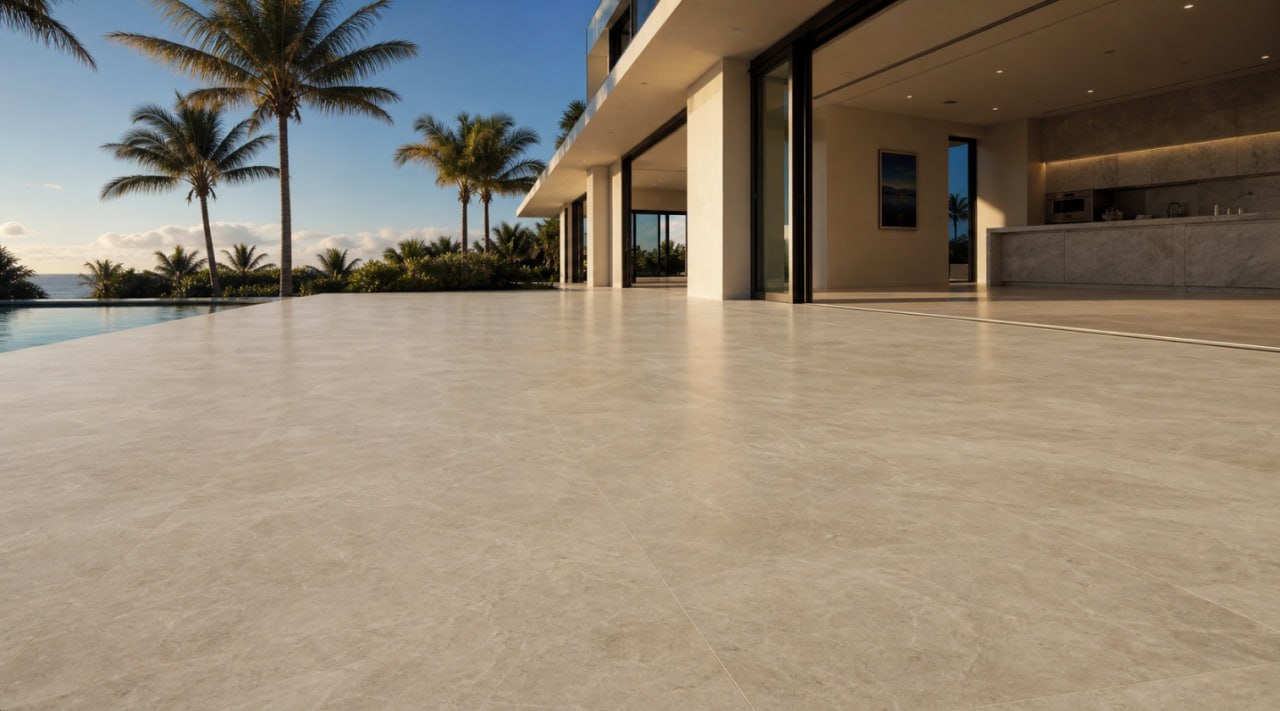
Large format porcelain pavers are less a product than a design language. Where a small unit reads as a pattern, a 24-by-48 module set with a hairline joint reads as a single, continuous plane. On a South Florida terrace that faces salt air and open sun, that seamless surface is not just a style choice. It rests on a specific, measurable material property. This is an essay about the format first, and about why porcelain is the body that makes the format worth specifying. For how it compares with the other options, see our guide to the best paver material for South Florida.
The monolithic aesthetic: fewer joints, more surface
The appeal of the large format is subtraction. Fewer units mean fewer joints, and fewer joints mean the eye stops reading a grid and starts reading a field. Daltile frames its extra-large-format porcelain around exactly this idea: very few joints, far less grout, and the scale and look of a natural-stone slab carried across a room or a terrace. The same material can run from an interior floor out to a pool surround, so the threshold between inside and outside quietly disappears.
Two details make that seamless field possible, and both are things a good architect specifies on purpose. The first is module size. Lines such as MSI’s Arterra offer true large formats, up to 24-by-48 inches, alongside 24-by-24 and a range of plank sizes, so a designer can compose a floor from a few large pieces rather than many small ones. The second is the edge. Rectified porcelain has its edges precision-cut after firing to a uniform dimension, and that calibration is what lets the joints pull in tight enough to disappear. Trade guidance for the slab look puts the minimum joint around a millimeter and a half to two millimeters with rectified edges. Without that machined edge, you cannot hold a line that fine, and the monolithic effect never arrives.
What porcelain actually is: the impervious spec
Under the surface is a specification, not a slogan. A tile qualifies as porcelain only if its water absorption is 0.5 percent or less when tested by the ASTM C373 method. That threshold is the “impervious” classification under ANSI A137.1, and it is the criterion the Porcelain Tile Certification Agency uses to certify a body as genuine porcelain. Porcelain earns that number because it is fired at very high temperature into a dense, nearly non-porous body.
The number holds at the size that matters here. This is not a claim about thin interior tile alone. MSI’s Arterra pavers are 2 centimeters, or 20 millimeters, thick and rated at less than 0.5 percent water absorption at that outdoor-paver dimension. Landmark’s Frontier20 is likewise a 20-millimeter porcelain paver. The impervious body and the large module coexist in one product on the market, which is the quiet fact the whole design depends on.
There is a strength floor beneath it as well. ANSI A137.1 requires porcelain tile to meet a breaking strength, tested by ASTM C648, of 275 pounds-force on average with no single tile below 250 pounds-force. Manufacturers of pedestal-set commercial pavers also publish much larger “breaking load” figures, in the range of a couple thousand pounds, but that is a different test describing a whole paver on supports, not the coupon standard. It is worth keeping the two apart rather than blending them into one impressive-sounding number.
Quick facts on 2cm large-format porcelain:
- Water absorption: 0.5 percent or less, the ASTM C373 “impervious” threshold under ANSI A137.1
- Breaking strength: 275 lbf average, 250 lbf minimum per tile (ASTM C648)
- Typical outdoor thickness: 2 cm (20 mm)
- Large-format modules: up to 24 by 48 inches, plus 24 by 24 and plank sizes
- Edge: rectified (precision-calibrated) for tight, slab-look joints
- Sealing: not required; the body is non-porous
Coastal performance as a consequence of that spec
Everything porcelain does well on the coast follows from the absorption number. If a surface will only take up a fraction of a percent of water, there is very little for salt spray or pool chemistry to soak into and carry inward. Belgard describes its commercial porcelain as unaffected by alkalis, acids, salt, and deicing materials, and its pavers as frost-free across a wide temperature range. Read that not as marketing but as the visible behavior of an impervious body: because the surface has almost nothing to penetrate, chloride has almost nothing to attack.
The honest way to see the advantage is by contrast with porous natural stone. Travertine and limestone are beautiful and have their place, but they absorb water and are sensitive to acids, so they are commonly resealed on a cycle often cited around every two to three years. Impervious porcelain asks for no sealing at all. That is a difference in porosity, not a verdict on stone. For a project where the look of quarried stone is the goal, our natural stone work is built for it. But on a salt-exposed field where the client wants to walk away from maintenance, the impervious body is the reason porcelain gets specified. The format reinforces it: fewer joints simply give moisture fewer seams to work into.
The installation reality
None of this is a sand-and-snap material, and that is precisely why it belongs in the hands of a specialist. The large format is unforgiving in ways that reward preparation and punish shortcuts.
Start with the base. Porcelain cannot be run over with a plate compactor the way concrete pavers can, so on a sand-set installation the bedding has to be compacted before the pavers go down and left dead flat. Large formats raise the stakes: because the pieces are big and thin, any hollow or high spot under them shows up as rocking and lippage, the uneven edge-to-edge height that ruins a slab-look field. The bigger and thinner the module, the less the base can hide, which is why a careful installer over-prepares rather than chases flatness afterward.
Handling and cutting are their own discipline. Big thin slabs are lifted and set with suction cups or a two-person suction frame so they land flat without stress. Cuts call for specialty tooling: a wet saw with a diamond blade rated for thick porcelain for notches and L-cuts, or a rated large-format manual cutter for straight runs. This is not equipment a general crew carries.
The install methods themselves are a menu, and each has a use. Landmark’s Frontier20 documents four: dry-set over a prepared grass, gravel, or sand base; bonded over reinforced concrete; over decking; and on a raised pedestal floor. Belgard likewise sets porcelain on pedestals for rooftops and directly over existing concrete. Pedestal systems in particular are what make porcelain the go-to for a rooftop terrace or a level deck over structure.
One caveat deserves its own line. Not all porcelain is rated for vehicular use. A 20-millimeter slab over gravel or sand is not automatically a driveway; because these pieces have a high length-to-thickness ratio, any vehicular loading generally calls for a rigid, low-deflection base engineered for it. If a driveway is in the plan, that is a conversation to have before a single slab is ordered. The same discipline that governs our pavers versus concrete decisions applies here.
Where large format porcelain pavers shine
The format finds its highest use where the surface is meant to be quiet. A minimalist pool surround, where the deck reads as one continuous plane rather than a busy pattern, is where the large module earns its keep, and it pairs naturally with the way we approach a pool deck. A patio that has to hold its line against salt air with no reseal cycle is another. And the seamless indoor-outdoor threshold, the same porcelain flowing from a living room out to the terrace, is the move that architects reach for when the whole point is outdoor living that feels continuous with the house.
That is the case for the format. Not a cheaper stone, but a deliberate, monolithic surface backed by a measurable, impervious body. To see how it reads at scale, browse our portfolio, or contact us to specify a large-format field for your own project.