Shellstone Pavers in South Florida: The Native Coastal Stone, Reconsidered
A design and heritage guide to shellstone pavers for Broward and Palm Beach homes: the coquina and keystone story, the three materials sold under one name, and how to select, seal, and live with native coastal stone.
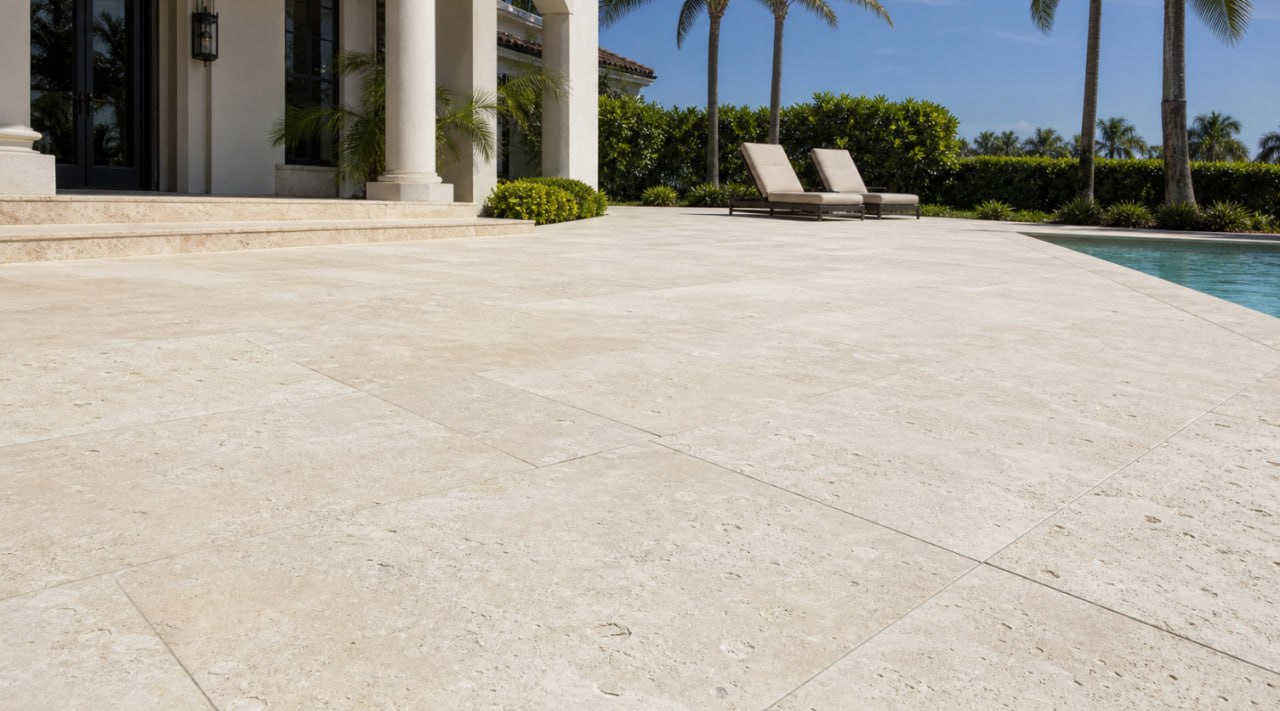
In St. Augustine, the oldest masonry fort in the continental United States has stood for more than three centuries against siege, storm, and salt air. The Castillo de San Marcos was built not of granite or fired brick but of coquina, a soft, light, porous limestone made of ancient shells cemented together and quarried from Anastasia Island just across the bay. That single choice of stone is the reason to look closely at shellstone pavers today. The material a South Florida homeowner is considering for a pool deck or courtyard is, at its root, the same native coastal stone that outlasted an empire’s cannon. For how it stacks up against the other options, see our guide to the best paver material for South Florida.
The fort that absorbed cannon fire
The provenance here is not marketing. The National Park Service, which stewards the Castillo, records that Spanish builders drew coquina for the fort from quarries on Anastasia Island for more than two hundred years, beginning construction in 1672 and completing the work in 1695. The stone’s defining quality is what the Park Service calls its millions of microscopic air pockets, which make it compressible rather than brittle.
That compressibility became legend during the British siege of 1702. Rather than shattering the walls, cannonballs fired at the Castillo burrowed into the coquina and stuck fast. The Park Service likens the effect to firing a BB into a block of foam. A peer-reviewed study of the fort’s endurance describes the mechanism as progressive local crushing: instead of fracturing across the wall, the stone absorbs impact energy pocket by pocket, so cracks do not propagate and no large fragments break away. A material that yields without failing is a rare thing, and it is worth understanding before you dismiss shellstone as merely decorative.
Florida’s native stones, in the ground beneath you
South Florida sits on a foundation of calcareous stone, and three formations tell most of the story.
The first is the Anastasia Formation, the source of the Castillo’s coquina. Florida Atlantic University geoscientists describe it as a Pleistocene coastal unit of interbedded sands and coquina limestone, its signature facies a rough, porous, orangish-brown rock of whole and fragmented mollusk shells set in a sand matrix and cemented by calcite. Traditionally estimated at roughly 100,000 to 130,000 years old, the formation takes its name from Anastasia Island near St. Augustine and runs some 250 miles down the Atlantic coast, south through Volusia, Brevard, Indian River, St. Lucie, and Martin counties and into Palm Beach County. In other words, this native stone underlies the very region a Broward or Palm Beach home occupies.
The second is the Miami Limestone, once called the Miami Oolite. FAU geoscientists explain that it is composed mainly of ooids, small coated carbonate grains built of concentric layers around a shell fragment or quartz nucleus, and that it forms the Atlantic Coastal Ridge running through eastern Miami-Dade and Broward. It was laid down roughly 125,000 to 130,000 years ago, during an interglacial period when southern Florida lay beneath a shallow sea. Freshly cut, it is reported to be soft and to harden on exposure to air and water, the classic quarries-soft, cures-hard behavior of these stones.
The third is the Key Largo Limestone, the true coral stone. The Florida Geological Survey describes it as a fossilized Pleistocene coral reef, a white to light-gray fossiliferous rock of coral heads encased in a sandy matrix, deposited when sea level stood higher. The decorative building stone quarried from it, known as keystone, was cut at the Windley Key quarry that Henry Flagler opened in the early 1900s to help build the Overseas Railroad. When you see the trade name keystone coral stone, this fossil reef is what it once meant.
Three materials, one confusing name for shellstone pavers
Here is where an honest guide earns its keep. Walk into a stone yard today and ask for shellstone, and you may be shown any of three genuinely different materials.
The first is true native Florida stone: quarried coquina or keystone coral, the heritage material described above.
The second is a manufactured product. The shellstone sold by a major regional maker such as Tremron is not quarried stone at all. It is a ground-face concrete paver that blends oyster shells and coquina into a standard paver mix, then grinds the surface to expose the shells. It is a handsome, consistent, engineered unit, but it is concrete with a shell finish, not native stone, and the trade name blurs that line.
The third is imported. Much of what is sold across the United States as shell stone is Turkish tumbled limestone marketed under the name, listed in stone yards right alongside Florida-made products. It is real limestone, simply not native to this coast.
None of these is a lesser choice on its own terms. But they differ in origin, in behavior, and in the provenance story they carry, and a buyer deserves to know which one is on the pallet. If you are drawn to shellstone for its regional heritage, ask plainly whether a given paver is quarried Florida stone, a shell-blended concrete unit, or imported limestone.
How shellstone lives on a luxury coastal home
Set provenance aside and the practical case is about caring for a soft, porous natural surface rather than fighting it.
Installers and suppliers who work with coquina and shell stone report a set of coastal virtues. Because the material is calcium carbonate, they say it is not attacked by the chlorine, bromine, or salt in pool water, a claimed advantage for saltwater decks in salt air. Light-colored shell stone is promoted as staying cooler underfoot than concrete or brick in direct sun, and as offering a naturally slip-resistant, quick-draining surface around a pool. These are trade observations rather than figures tied to a published standard, so treat them as the practitioner’s experience they are. They align with what the material is: a pale, porous, calcareous stone.
The stewardship side is straightforward and, for a fine home, part of the pleasure. Because the stone is porous, suppliers advise sealing it and resealing periodically, on the order of every one to two years in Florida conditions, and pairing coastal installations with sealers formulated to block salt and resist UV. Cleaning calls for mild, pH-neutral products, since acids etch calcium-carbonate stone. Think of this the way a fine-home owner treats hand-cut limestone or reclaimed timber: not as a maintenance chore but as the ordinary care a natural material asks in exchange for a surface that gains character with age. Homeowners do report that the stone is soft and can scratch, chip, or stain if left unsealed, which is simply the other face of the compressibility that makes it beautiful and historic.
Is shellstone right for your home?
Shellstone rewards a particular kind of owner: one who wants a surface of genuine local provenance, is drawn to a warm, shell-flecked, of-this-place texture, and is content to seal and tend a soft natural stone rather than choose a set-and-forget concrete. It suits a pool deck, a patio, or a courtyard where barefoot comfort and coastal character matter more than indestructibility. An owner who wants zero upkeep and maximum hardness may be happier with an engineered natural stone alternative or a through-body concrete paver, and we will say so.
The most important step is clarity about what you are buying. Decide whether you want quarried native stone, a shell-faced concrete unit, or imported limestone, then design the pool deck or patio around that material’s color, finish, and care from the start. To weigh shellstone against the other surfaces we install, our pavers versus concrete guide and our pool deck pavers guide go deeper on how each holds up here.
To walk your own project and talk through native stone with people who install it in Broward and Palm Beach every week, browse our portfolio or contact us.