Landscape Design Trends 2026: A South Florida Hardscape Brief
The 2026 landscape design trends that matter for Palm Beach and Broward: outdoor rooms, warm neutrals, large-format porcelain, soft layouts, permeable pavers and integrated lighting, read through a coastal, no-freeze, hurricane-drainage lens.
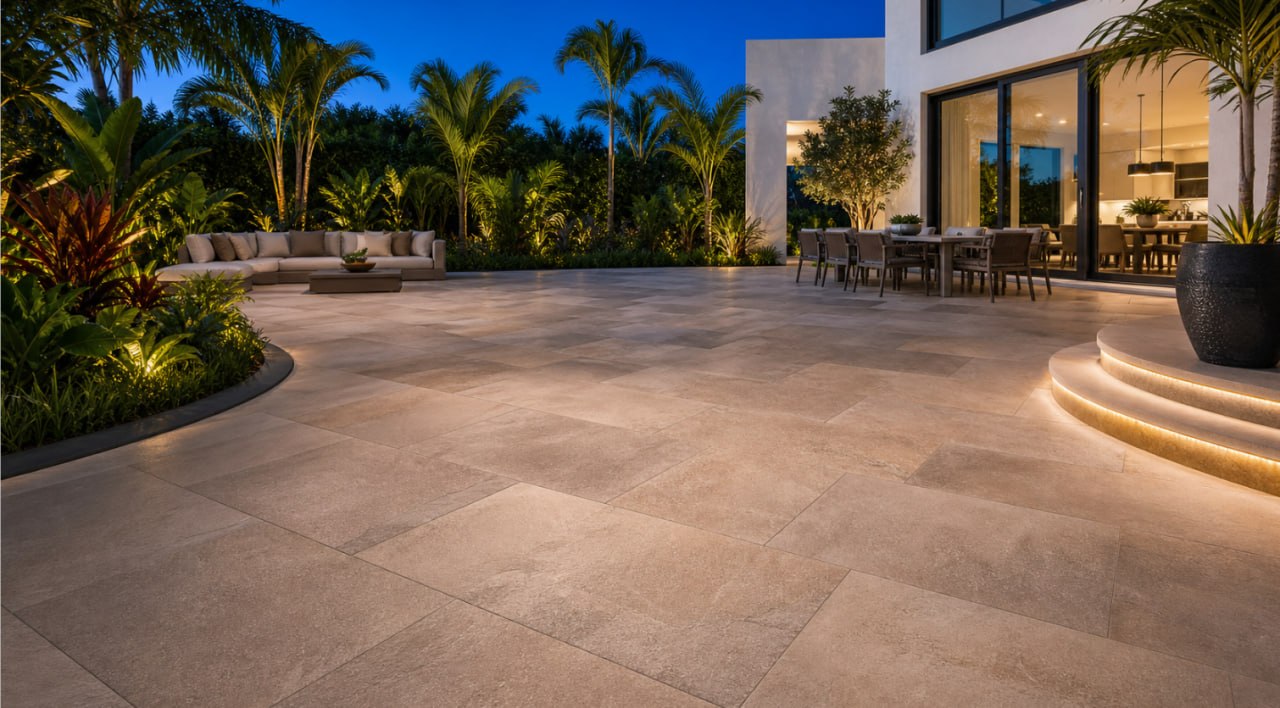
The landscape design trends 2026 name in the national reports read differently in South Florida than they do elsewhere. Palm Beach and Broward do not have a freeze-thaw season, do have salt air and intense coastal light, and treat the backyard as a room that is used every month of the year. This brief takes the most credible 2026 trend research, from the Houzz Outdoor Trends Study to Yardzen’s report and the National Association of Landscape Professionals, and reads each movement through that local lens. It is written for the discerning homeowner, and the architect at their side, who want to know which directions are worth committing a hardscape to.
The through-line across every serious 2026 source is the same: the outdoors is being designed for living rather than for listing. That single shift reorders the priorities below.
The landscape design trends 2026 at a glance
| Trend | Named source | South Florida reading |
|---|---|---|
| Outdoor rooms over showcase lawns | 2026 Houzz study; NALP (late 2025) | A year-round living wing, not a summer bonus |
| Soft, curved layouts and shrinking lawns | Yardzen 2026 report | Curves that also route hurricane-season runoff |
| Warm neutrals displacing cool grey | Unilock, Techo-Bloc, corroborated across makers | Mineral tones that hold up under coastal UV |
| Large-format, near-monolithic surfaces | Belgard (2026); NALP | Fewer joints, cooler underfoot, calmer sightlines |
| Authentic materials and porcelain | NALP (late 2025) | Stone and porcelain suited to salt and sun |
| Permeable, eco pavers | CMHA/ICPI technical guidance | Answers stricter impervious-surface limits |
| Integrated lighting and synthetic turf | NALP (late 2025); Houzz | Extends the usable evening; a defined turf role |
Outdoor rooms, designed for living not listing
The headline finding of the 2026 Houzz Outdoor Trends Study is a change in motive. A larger share of homeowners now renovate outdoor space for everyday living rather than resale, and the lounge or seating zone is the single most common feature they build, well ahead of dining, a quiet reading retreat, gardening and outdoor cooking. The National Association of Landscape Professionals, writing in late 2025, named the “defined outdoor room” its leading 2026 direction: intimate, zoned areas replacing the large showcase lawn.
In most of the country this is a seasonal upgrade. Here it is the premise of the house. A Palm Beach property can hold a shaded lounge, an open dining terrace and a quiet corner that all earn their keep in January as easily as in July. The 2026 Houzz study also records more homeowners hiring a professional, and landscape contractors specifically, which tracks with the ambition of these projects. Zoning a yard into rooms is a planning exercise before it is a hardscape one, and it is the foundation of our outdoor living work.
Soft, curved layouts and the shrinking lawn
Yardzen’s 2026 report, covered by Forbes in July 2026, calls the year’s defining move the “soft yard”: curved pathways and organic geometry displacing rigid rectilinear plans. The same report measures a steep year-over-year decline in traditional lawn square footage alongside a marked rise in native plantings and pollinator gardens. The 2026 Houzz study points the same way, with fewer homeowners choosing natural grass as hardscaping and turf take a larger share.
For South Florida this is more than a stylistic preference. A curved patio edge or a gently arced walkway can be laid out to guide heavy seasonal rain toward planted, absorbent ground rather than sheeting it at the house. Softening the plan and shrinking the lawn, done deliberately, is also a drainage decision.
Warm neutrals displace cool grey
The clearest material shift for 2026 is a retreat from cool grey toward warm mineral neutrals: beige, taupe, clay, sandstone and weathered tones. Unilock frames it as a move away from cooler greys toward tones inspired by natural stone, clay and weathered materials, and manufacturers such as Techo-Bloc position warm neutrals and natural texture over flat grey in the same season. Because the direction is corroborated across several makers, it is fair to read it as a widely reported industry movement rather than one brand’s styling.
Under our coastal light the case is practical as well as aesthetic. Warm mineral tones read as grounded and inviting in strong sun where cool grey can flatten, and through-body paver color, where the tone runs through the unit, weathers salt and UV without exposing a different layer as it wears. It is the palette shift most likely to age gracefully on the coast.
Large-format surfaces and the monolithic look
Belgard reports large-format expansion with narrow joints as a preferred 2026 patio direction, and NALP places porcelain among its named durable materials. The intent is a calmer, near-monolithic surface: bigger units, fewer joint lines, a quieter plane underfoot.
That look suits South Florida for reasons beyond fashion. Fewer joints mean fewer seams for organic growth in a humid climate, and broad porcelain formats stay comparatively cool, which matters on a terrace walked barefoot much of the year. The barefoot comfort logic is the same one we lay out in our pool deck pavers guide, and it carries onto the patio.
Authentic materials, and porcelain’s arrival
NALP names authentic natural materials, genuine stone, warm-toned pavers, porcelain and reclaimed wood, as a leading 2026 trend, favored over synthetics for their craft and durability, and it names porcelain specifically among the durable materials of choice. Manufacturers such as Belgard describe porcelain moving into the mainstream for its low-maintenance, stain and moisture-resistant, slip-resistant surface.
The regional reframe is ours: in a salt-air, high-UV, no-freeze setting, the freeze resistance northern guides emphasize is beside the point, while resistance to staining, fading and slip is central. That is what makes both genuine stone and porcelain compelling here, and it informs how we specify natural stone. It also revisits the through-body durability argument from our pavers versus concrete comparison, now applied to a wider material set.
Permeable and eco pavers
Permeable pavers are rising as regulators tighten impervious-surface limits and homeowners look for stormwater performance. Guidance from the Concrete Masonry and Hardscapes Association, drawing on established interlocking-pavement engineering, describes permeable systems that let rain move down through joints and base rather than sheeting off the surface, and that can let greenery grow between units.
Nowhere is that more relevant than here, where hurricane-season downpours arrive in sheets and drainage is a code and design requirement rather than an afterthought. Treating a driveway or terrace as part of the site’s water strategy is one of the more durable 2026 ideas for this coast, not a passing look.
Integrated lighting and a defined role for turf
NALP lists app-controlled “automated experiences,” lighting among them, as a top 2026 trend, and designers increasingly integrate low, cohesive lighting into steps, wall caps and edges so a landscape reads as one composition after dark. In a climate where evenings are the most comfortable hours to be outside for much of the year, integrated lighting is what makes the outdoor rooms above genuinely usable past sunset.
Synthetic turf, meanwhile, has earned a defined role. NALP names it a top 2026 trend, if a debated one among professionals, and the 2026 Houzz study records a clear jump in adoption. In water-conscious, high-heat South Florida it is best read as one considered tool within a design, a low-maintenance panel between planted and paved zones, rather than a wholesale replacement for either.
Reading 2026 for this coast
The common thread is restraint in service of use: rooms instead of lawns, warm mineral tones instead of cool grey, broad quiet surfaces instead of busy joints, and water treated as a design input rather than a nuisance. Each of these national trends holds up in Palm Beach and Broward, but only after it is filtered for salt, sun, and the reality that the yard is lived in every month. To translate the 2026 brief into your own site, drainage and light included, browse our portfolio or contact us.