Pavers vs. Concrete in South Florida: Which Is Better for Your Driveway, Patio & Pool Deck?
A balanced pavers vs concrete comparison for Broward and Palm Beach homeowners: cracking, repairs, strength, UV fade, salt air, drainage and resale, framed for South Florida.
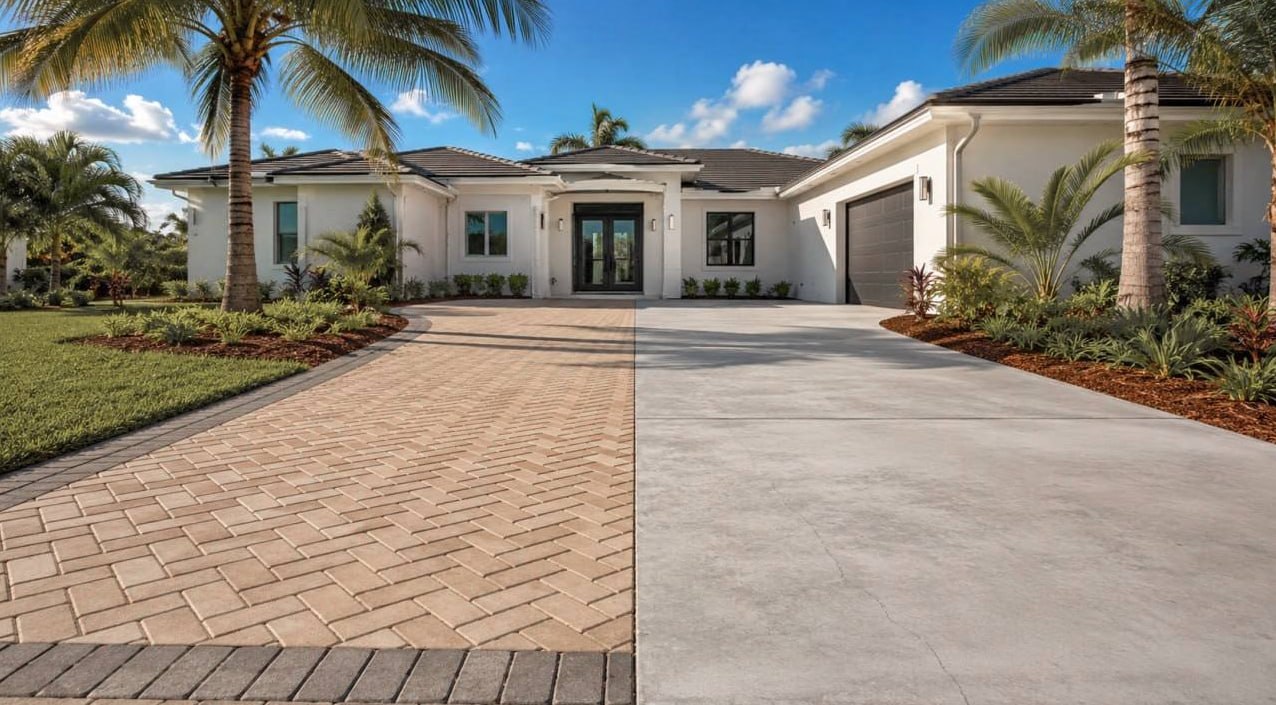
If you are weighing pavers vs concrete for a driveway, patio, or pool deck in Broward or Palm Beach County, most advice online was written for a different climate. Northern guides lead with freeze-thaw cracking, which does not happen here. What actually decides how these two surfaces hold up in South Florida is loose sandy soil that settles, salt air near the coast, intense UV, heat underfoot, and heavy seasonal rain. This guide compares pavers and poured or stamped concrete on those local factors and says plainly where poured concrete still makes sense.
Pavers vs concrete: the quick comparison
Here is the head-to-head on the factors that decide most South Florida projects.
| Factor | Pavers | Poured / stamped concrete |
|---|---|---|
| Cracking & soil movement | Discrete units over a flexible base flex with minor settlement without cracking | A rigid slab distributes load by bending, so it is expected to crack; joints only control where |
| Repairability | Lift the affected units, fix the base, reset the same units, no visible patch | Cracks and settled sections are patched or resawn, and patches rarely match |
| Strength (units) | Tested to a high minimum under ASTM C936 | No comparable per-unit product standard for typical residential flatwork |
| Maintenance | Joint sand top-up, optional seal; color is often through-body | Stamped color is surface-applied and needs periodic re-sealing in our sun |
| Curb appeal & resale | A premium, upgradeable finish buyers notice | Functional, and stamped can look good until the color fades |
| Drainage | Segmental surface with permeable options suits heavy rain | Solid slab sheds water; needs designed slope and joints |
One caveat: the strength and flex rows rest on published standards, the maintenance and repair rows combine a standard with installer practice, and the resale row is general, not paver-specific.
Cracking and soil movement: the real South Florida decider
This is where the two surfaces differ most. A poured concrete slab is a rigid pavement: it carries load to the ground through flexure, meaning it bends, and a monolithic slab that bends under uneven support eventually cracks. The control joints cut into a driveway do not prevent this. As concrete-repair educators explain, those joints are pre-planned weak lines meant to force the inevitable shrinkage crack along a straight hidden line instead of wandering randomly across the surface. A poured slab is expected to crack; the joints only manage where.
Interlocking pavers work differently. Per ICPI/CMHA Tech Spec 4, an interlocking concrete pavement is a flexible system: loads transfer between units through vertical, horizontal, and rotational interlock, with sand in the joints carrying shear and a herringbone pattern resisting lateral movement. Because the surface is many discrete units over a flexible base rather than one slab, it takes up minor ground settlement without the cracking a rigid slab would show.
Now the local part. South Florida sits on sand. University of Florida IFAS Extension notes our sandy soils drain very fast and hold little water, with a field capacity near ten percent and a permanent wilting point near three percent by volume. That low-cohesion sand settles unevenly under load if it is not well compacted, and heavy rain can scour a poorly prepared base. A rigid slab over settling sand is a crack waiting to happen; a segmental paver surface over a properly compacted, edge-restrained base can ride out that same movement. This is the northern freeze-thaw argument replaced with the mechanism that actually applies here.
Repairability: what happens after something settles
No surface is immune to a base problem, a utility dig, or a tree root. What differs is the fix.
With pavers, the repair is designed into the system. ICPI Tech Spec 6 covers reinstatement: you lift the affected units, correct the base underneath, and reset the same pavers, with no material hauled to a landfill and no visible patch. One honest caveat is that this clean reset applies to sand-set pavers; asphalt-bedded units are much harder to reinstate. But for a typical sand-set driveway or patio, a settled corner can be reset to look like new.
A poured or stamped slab does not offer that. A crack gets filled or the section gets sawcut and repoured, and the repair almost never matches the surrounding color and texture, especially once a stamped surface has aged in our sun. To be fair, pavers with a poor base or neglected joints can shift and grow weeds, so installation quality matters as much as material choice.
Strength: what the standard actually says
Paver units are held to a real product standard. To be sold as interlocking concrete pavers, they must meet ASTM C936, with strength tested per ASTM C140. Per ICPI/CMHA, that means an average compressive strength of 8,000 psi, with no individual unit below 7,200 psi. There is no equivalent per-unit product standard for the ready-mix used in typical residential flatwork. We are not quoting a number for that poured concrete, because no authoritative figure for residential slabs was sourced; the paver minimum is a hard standard, while residential slab strength is not standardized the same way.
Load behavior matters for driveways too. For vehicular use, Tech Spec 4 specifies a minimum paver thickness of 80 mm (about 3.125 inches) with a length-to-thickness aspect ratio no greater than 3:1. Under repeated traffic the base actually stiffens, a documented lock-up effect where the surface gains structural capacity as it is used. So a paver driveway built to that spec is engineered for cars, not just looks.
Salt air, UV, and heat: the coastal and climate factors
Near the coast, salt is part of the environment, and national articles overstate it. Salt-driven corrosion of embedded reinforcing steel is a well-established problem for reinforced concrete: salt penetrates, the rebar corrodes, and the expansion spalls and cracks the slab. But a thin unreinforced patio or pool-deck slab has no rebar to corrode, so for most residential flatwork the coastal concern is not structural failure; it is surface staining and salt exposure on the finish.
UV and color are the bigger everyday difference. In Florida’s direct sun the color on stamped concrete is skin-deep, a surface-applied system that installers report can fade within a couple of years without a UV-resistant sealer, and the sealers break down faster here than in milder climates. Industry maintenance guidance commonly puts stamped concrete on a re-seal cadence of roughly every two to three years. Paver color, by contrast, is often through-body, so when a paver chips or wears it does not expose a different-colored layer the way a worn surface stain does. Treat the fade timelines as installer estimates, but the difference in how color is built into each product is real.
Heat underfoot follows the same color rule. Installers report unsealed concrete in direct sun can reach roughly 140 to 160 degrees, and that light surfaces run cooler than dark ones; treat those as trade observations, not measurements. If barefoot comfort near the water is your priority, the deeper heat-and-slip breakdown is in our pool deck pavers guide, and we plan any pool deck around color and finish first.
Drainage in heavy rain
South Florida rain arrives in sheets, and drainage is a design requirement. A solid concrete slab sheds all of its water, so it has to be sloped and jointed to move that volume off the surface. A segmental paver surface handles water differently, and permeable paver systems can let rain move down through the joints and base, which suits our downpours. For a patio or walkway that sits low or near the house, weigh that early with your installer.
Curb appeal, resale, and where concrete still wins
Outdoor improvements carry real resale weight. In the National Association of Realtors 2023 Remodeling Impact Report on outdoor features, standard lawn care service recovered about 217 percent of its cost, the highest in the report, and an overall landscape upgrade recovered 100 percent. A new patio in that report is widely cited at around 95 percent cost recovery, though that figure comes through secondary reporting rather than NAR’s primary chart, and it covers patios as a category, not pavers versus concrete. So treat resale as a strong general reason to invest outdoors, not proof that one surface beats the other by a set percentage.
To be balanced, poured concrete still makes sense in some cases. For a plain utilitarian slab where appearance and future repairs are not priorities, it is a simple, reasonable choice that can look clean and modern. The trade-offs are the ones above: a rigid slab is expected to crack over settling sand, repairs are visible, and stamped color needs re-sealing to fight our sun.
The bottom line for South Florida
Forget freeze-thaw; it is not a factor here. The pavers vs concrete decision comes down to how each surface handles loose sandy soil, coastal salt, strong UV, heat, and heavy rain. Pavers flex with minor ground movement, repair without a visible patch, carry through-body color, and meet a real strength standard; poured and stamped concrete is simpler and can look sharp, but it is built to crack over our sand and its color is on borrowed time.
To walk your own yard and drainage with someone who installs these surfaces here every week, browse our portfolio, see the areas we serve, or contact us to talk through your project.