Paver Patterns as a Design Language: Herringbone, Ashlar & the Art of the Laid Surface
A connoisseur's guide to paver patterns for Broward and Palm Beach homes: herringbone, running bond, basketweave and ashlar as a design language, with the structural logic behind each.
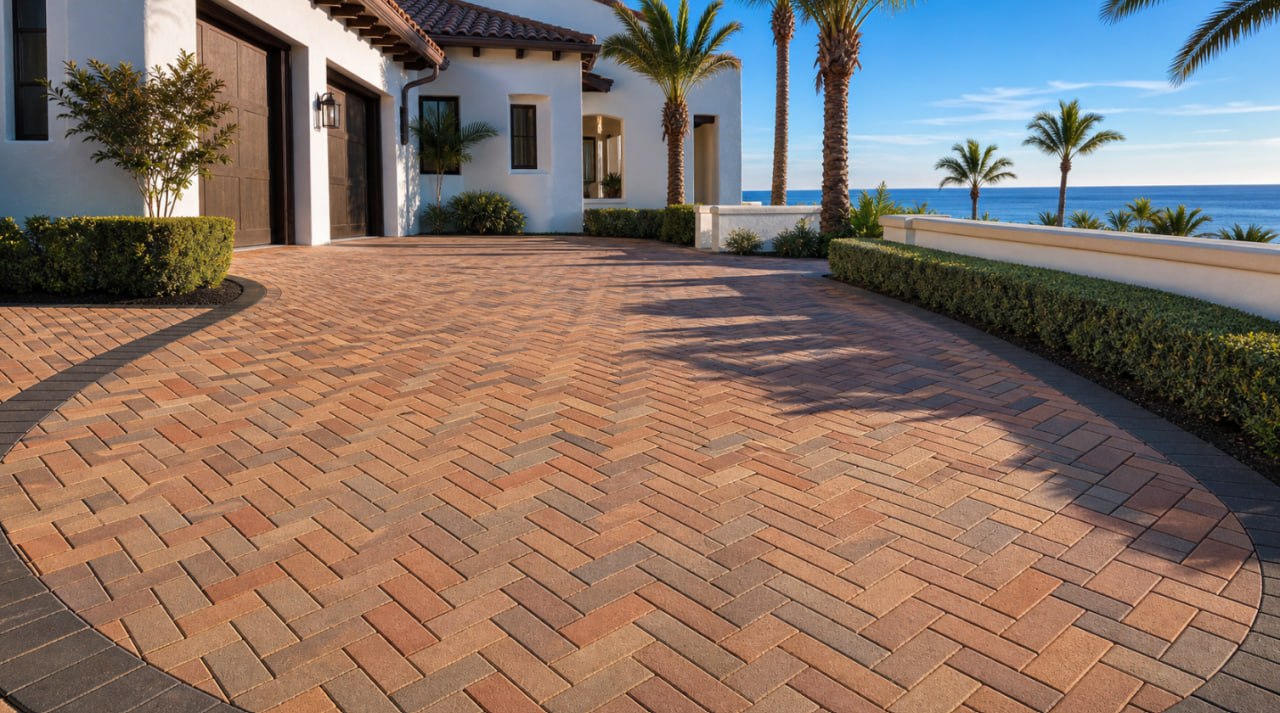
A paved surface is never neutral. Long before color or material register, the eye reads the pattern: the direction the units run, the scale of the repeat, the crispness of the border. Paver patterns are a design language, and fluency in it is what separates a considered hardscape from a merely tiled one. The same clay or concrete unit can read as tailored and modern or relaxed and timeless depending entirely on how it is laid. This guide treats the main paver patterns as composition rather than catalog, and pairs each with the structural logic that decides where it belongs.
The vocabulary: paver patterns at a glance
Every pattern carries both a character and a job. Some elongate a space; some hold their ground under a two-ton vehicle. The table below is the quick reference; the sections that follow give the reasoning behind it.
| Pattern | Character | Best use | Structural note |
|---|---|---|---|
| Herringbone (45° or 90°) | Directional energy, repeated V shapes | Driveways and high-load surfaces | The strongest interlock; recommended for vehicular traffic |
| Running bond | Clean linear lines, elongating | Walkways, narrow or smaller spaces | Weaker interlock; a pedestrian pattern |
| Basketweave | Woven, classic, colonial | Patios, courtyards, traditional homes | Timeless and durable for foot traffic |
| Ashlar / random ashlar | Tailored, cut-stone, modern | Patios and terraces wanting a stone look | Mixed sizes in a defined repeat |
| Circle / European fan | Radial focal point | Accents around fire pits, dining zones | A challenging, craftsmanship-heavy lay |
Herringbone: the structural star
Herringbone is the one pattern where beauty and engineering agree completely. Its interlocking V shapes are not only the most visually energetic of the common layouts; they are, per ICPI and CMHA guidance, the most effective at maintaining interlock. The industry Tech Spec is direct on this point: testing has shown herringbone offers greater structural capacity and resistance to lateral movement than other laying patterns, which is why it is the recommended pattern for surfaces that carry vehicles.
The mechanism is worth understanding, because it explains the whole hierarchy. A driveway does not just bear weight; it absorbs the horizontal push of tires braking, turning and accelerating. That push causes creep, the slow lateral migration of units. Herringbone disperses those horizontal forces across many units better than any other pattern, which is precisely what a running or stack bond, with its long uninterrupted joint lines, cannot do. This is the citation-worthy fact: herringbone beats running and stack bond structurally. The difference is real and measured.
One point deserves care. Herringbone can be set at 45 degrees or at 90 degrees to the field, and installers often favor the 45-degree orientation for driveways. Treat that as an aesthetic and craft preference rather than an engineering ranking. The standards endorse both 45- and 90-degree herringbone equally for vehicular use; neither is stronger than the other in the spec. What differs is the labor. A 45-degree layout must be cut fully at every edge, while a 90-degree layout is set out mostly with half cuts, so installers typically plan for roughly 10 to 15 percent more material on the angled version to allow for offcuts. That is a trade estimating habit, not a rule.
Herringbone’s authority is ancient. The pattern has roots in Roman roadwork, where it was known as opus spicatum, or spiked work, its perpendicular bricks resembling the bone structure of a herring. Roman roads laid this way carried heavy loads and required little maintenance, and surviving stretches remain walkable today. The engineering the Romans arrived at by instinct is the same one the modern Tech Spec confirms by test.
Running bond and basketweave: the timeless pedestrian patterns
Where herringbone performs, running bond composes. Laid in staggered rows like brick coursing, each unit offset from the one before, it produces strong linear lines that can create the illusion of length. That directionality is a designer’s tool: run the bond down a narrow walkway and the path reads longer and more graceful. It also generates the least waste, since it is set with minimal cutting. Structurally it is weaker than herringbone, with none of the interlocking resistance to lateral load, which is why it belongs on foot traffic rather than under tires.
Basketweave trades direction for texture. Alternating vertical and horizontal pairs form a woven surface with a quiet, classic rhythm, historically associated with colonial and traditional homes. It has grown less common, which is part of its appeal for a client seeking something that feels heritage rather than default. On a courtyard or a garden terrace it holds up handsomely.
Ashlar: tailored modern, from cut-stone masonry
Ashlar is the pattern of restraint. Borrowed from cut-stone masonry, it combines multiple paver sizes in a layout that reads as irregular yet follows a defined repeating module. The result mimics the look of dressed natural stone: composed, tailored, quietly modern. For a terrace that wants the gravitas of stone without a single dominant direction, random ashlar is often the most sophisticated choice on the board.
Formal versus organic, and the discipline of the border
Choosing a pattern is partly a choice between formal and organic. Directional patterns such as herringbone and running bond assert order and movement; ashlar and fan layouts feel looser and more natural. Setting a field at 45 degrees to the house adds visual energy and can make a smaller space read wider, a lever worth pulling deliberately.
Whatever the field, the border is what makes it look finished. A soldier course sets border units with their long sides touching, standing shoulder to shoulder for a deeper frame; a sailor course sets them short side to short side for a shallower one. The frame is not only decorative. On vehicular pavement the Tech Spec calls specifically for sailor courses at the perimeter, and behind them an edge restraint, because a firm border provides the horizontal interlock that holds the field against creep. Interlock is a system, not a single choice: pattern, unit thickness of 80 millimeters, or about 3-1/8 inches, for driveways, tight joints, and a restrained edge working together. Even the cutting is governed. No cut piece exposed to tire traffic should be smaller than one-third of a paver, which is why a crisp, well-planned border is a mark of craft rather than mere tidiness.
Choosing your pattern
Read the surface and its demands together. Herringbone for anything that carries vehicles or wants strong visual energy. Running bond to elongate a walkway or a slender terrace with minimal fuss. Basketweave for a heritage patio or courtyard. Ashlar for the tailored calm of cut stone. A circle or European fan, laid center-first and worked outward, to anchor a fire pit or dining zone as a deliberate focal point.
The right pattern controls scale, direction and mood while respecting how the surface will actually be used. That is the whole discipline: composition and load, resolved in the same gesture. To see these patterns realized across South Florida homes, browse our portfolio, or contact us to plan the layout for your driveway, patio, walkway or pool deck. If you are still weighing materials, our guides on pavers versus concrete and pool deck pavers go deeper.