Pool Deck Paver Replacement: What Belongs in the Estimate?
Compare pool deck paver replacement estimates by removal, preparation, retained features, product selection, access and responsibility for unexpected work.
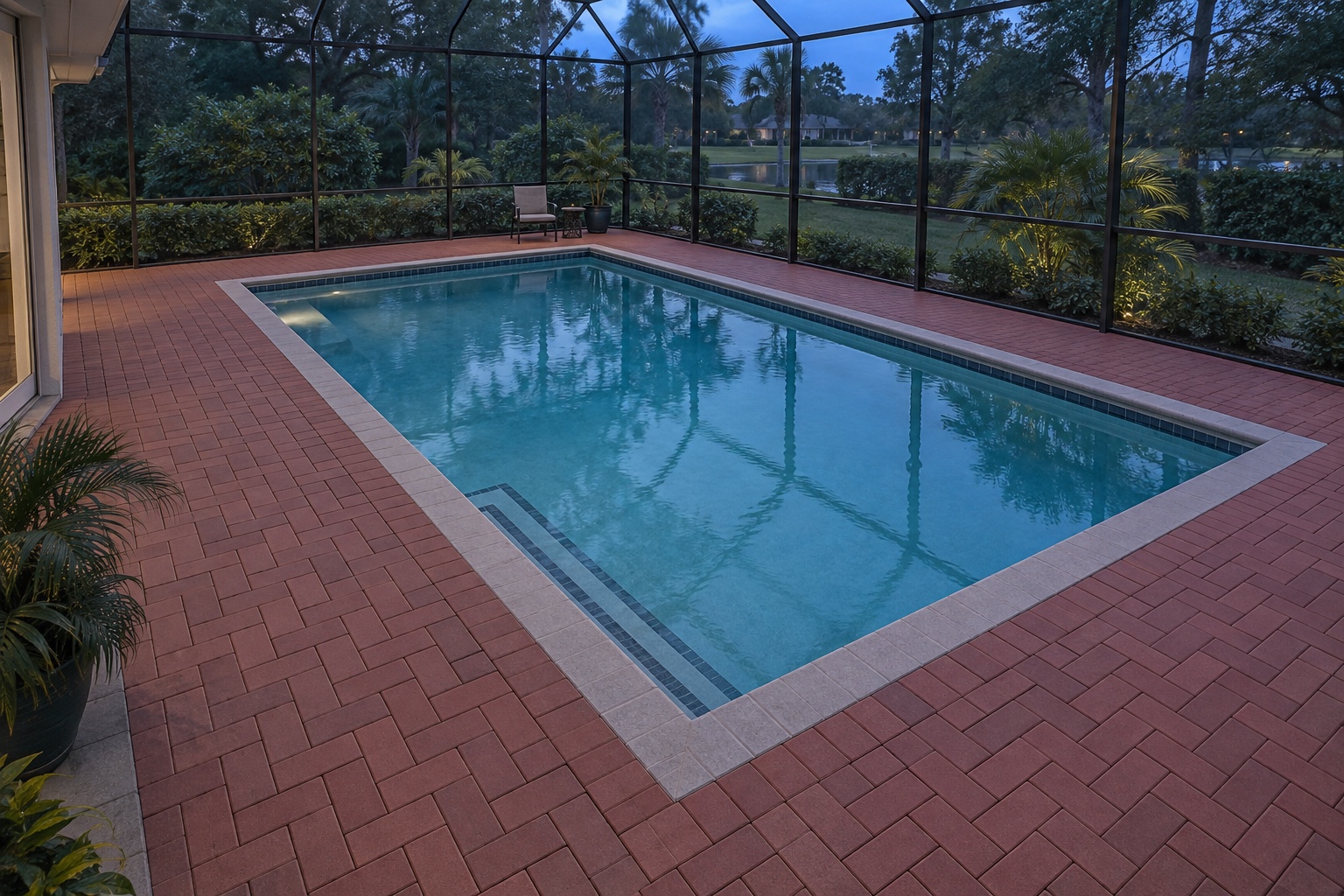
Hero illustration: AI-generated pool deck concept, not a completed project.
A pool deck paver replacement estimate should define the exact work area, retained items, demolition and disposal, underlying preparation, selected product, finished levels and drainage connections. It should also cover access, protection, reinstatement and responsibility for discoveries after removal. Color and square footage alone cannot describe the job. Site conditions determine the scope: keeping existing coping, meeting a door threshold or working inside a screen enclosure can change what needs attention. Compare those written boundaries before comparing the total.
For pool deck pavers in Boynton Beach, a useful proposal connects the surface you want with the existing features the installation must accommodate.
Confirm which job is being priced
Replacement means removing the identified existing surface and installing new pavers. Re-laying uses existing pavers again within an agreed area. Cleaning treats the surface already there. Ask the estimator to name the proposed work and explain why it addresses your concerns; a tired appearance alone should not decide the replacement question.
If competing proposals assume different construction routes, our pool deck lift-or-overlay comparison helps frame that separate decision. Settle the route before requesting comparable replacement scopes. A proposal that retains an existing support layer and one that removes it have different boundaries, even if their finished colors match.
When a maintenance estimate is a different job
If assessment finds that surface treatment is sufficient, compare a paver cleaning and sealing scope before committing to removal. Cleaning, joint replenishment and sealing should be identified individually, with necessary preparation stated.
CMHA’s Cleaning, Sealing and Joint Sand Stabilization of Interlocking Concrete Pavement distinguishes cleaning and preparation from joint stabilization and sealing. It describes maintenance operations, not a method of rebuilding a failed base. Ask for separate assessment of movement or drainage concerns rather than treating sealer as their correction.
Mark the area and the stopping points
Prepare a simple sketch and photographs of the full pool surround, doors, drains, coping and steps. Mark adjoining sitting areas and paths separately. Identify which surfaces you want replaced and which should stay, including any border whose color you want to preserve.
During the site visit, have the contractor confirm measurements and exact limits. Ask whether the quoted area includes borders, step surfaces and connecting sections, and how those items are measured. A single total can hide different assumptions about those smaller areas.
Photograph existing damage to retained features together. The sketch records your intentions; the contractor still needs to confirm feasible boundaries and identify conditions that cannot be established until removal.
Separate essential replacement work from optional layout changes. Keeping the same footprint, enlarging a sitting area and adding a connecting path should be distinct choices on the proposal. This lets you preserve the features you value without leaving the estimator to guess which improvements belong in the total.
Separate demolition from underlying preparation
The removal line should identify the surface and layers being removed, loading, disposal and what remains. If usable pavers will be saved for another purpose, record where they will be stored and who moves them. Otherwise, do not assume salvage is included.
The preparation line needs its own description. Ask what examination and correction of the exposed support are included, what the proposal assumes can stay, and which findings would require a revised scope. “Prepare as needed” leaves you unable to compare what contractors have actually allowed for.
CMHA’s Guide Specification for the Construction of Interlocking Concrete Pavement is a tailorable guide, not Florida law. Section 3.02 calls for verification of site conditions, base, elevations and drainage inlets before installation. Section 1.04 addresses a mockup for reviewing the proposed work. These are useful prompts for discussing checks and approvals in your estimate, not a ready-made specification for your pool deck.
Record the product and its connections
Specify the manufacturer, product line, unit size, thickness, color, finish, pattern and border selection for the proposed assembly. Have the contractor explain the selection for this site rather than accepting an unspecified “standard” product. Include the proposed joint material and any optional surface treatment separately.
Review a physical sample beside the retained coping. Record your approval of the product and finish, and have the contractor confirm suitability for the intended poolside use with the supplier. A color sample cannot establish wet-use performance or promise barefoot comfort.
Ask how the finished surface will meet doors, coping, steps, gates and drains. The estimate should identify adjustments and who designs or confirms them. Neither a generic slope nor a universal thickness resolves those site-specific connections. Approval of the look should not leave these junctions undecided.
Assign responsibility for retained features
Use a short responsibility matrix during the walkthrough. Replace general references to “others” with the party who will handle each task.
| Retained feature | What the estimate should resolve | Responsibility to assign |
|---|---|---|
| Coping | Protection, edge connection and any separate repair | Deck contractor and pool specialist, as needed |
| Drains | Protection, finished connection and any proposed alteration | Deck contractor and appropriate drainage or pool trade |
| Pool equipment | Protected access and any work affecting its services | Deck contractor and relevant pool or electrical trade |
| Barriers and screen enclosure | Protection, access arrangements and any reinstatement | Deck contractor and appropriate enclosure or barrier trade |
An exclusion still needs a next step. If another specialist must assess an item, identify who arranges that assessment and how its findings reach the estimator. Pool drains, electrical systems and barriers need the appropriate professional involvement.
To develop this into a proposal, request an assessment through our pool deck installation service. Bring your sketch and photos for an on-site review, then ask for a proposed written installation scope identifying retained features, included preparation and unresolved specialist work.
Include access, protection and reinstatement
Walk the removal and delivery route, including side gates, planting and surfaces crossed by workers or equipment. Have the estimate identify staging space and responsibility for protecting the pool, house and enclosure during the work. Discuss household access while the deck is unavailable.
List what will be put back: moved furniture, disturbed planting, access surfaces and any agreed enclosure components. Include debris removal and final cleanup. If approvals are needed, determine them from the actual address and scope, and name who confirms requirements and handles submissions.
Resolve discoveries before extra work
Hidden conditions deserve a process, not a guessed allowance presented as certainty. Ask who photographs a discovery, explains its effect and prepares the proposed correction. Agree that changes in work and price will be documented for your approval before extra work proceeds. Any uncertain item should have a stated assumption and a way to resolve it.
If an allowance appears in the estimate, ask exactly what it covers and how the final amount will be established. Identify who can approve a substitution if the selected product is unavailable; a replacement product needs its own review of appearance and suitability.
Compare proposals against the same sketch and responsibility list. Check whether each line is included, optional, excluded or awaiting investigation. At the final walkthrough, use that agreed scope to review the installed product, transitions, reinstatement and any outstanding items. Request care and return-to-use instructions for the actual installation.
For a pool deck replacement consultation in Boynton Beach, share your photos, retained-item preferences and questions about competing estimates. Request a site assessment and proposed written installation scope so you can review the work boundaries and remaining decisions before approving the project.
Keeping a screen enclosure during replacement? Our pool deck and screen-enclosure planning guide explains which boundaries, access needs and separate professional responsibilities to discuss before accepting the proposal.