Green Patches on Shaded Pavers: Cleaning and Site Checks
Plan care for green-looking patches on shaded pavers: record wetness and material, arrange assessment, and compare cleaning, site checks and sealing.
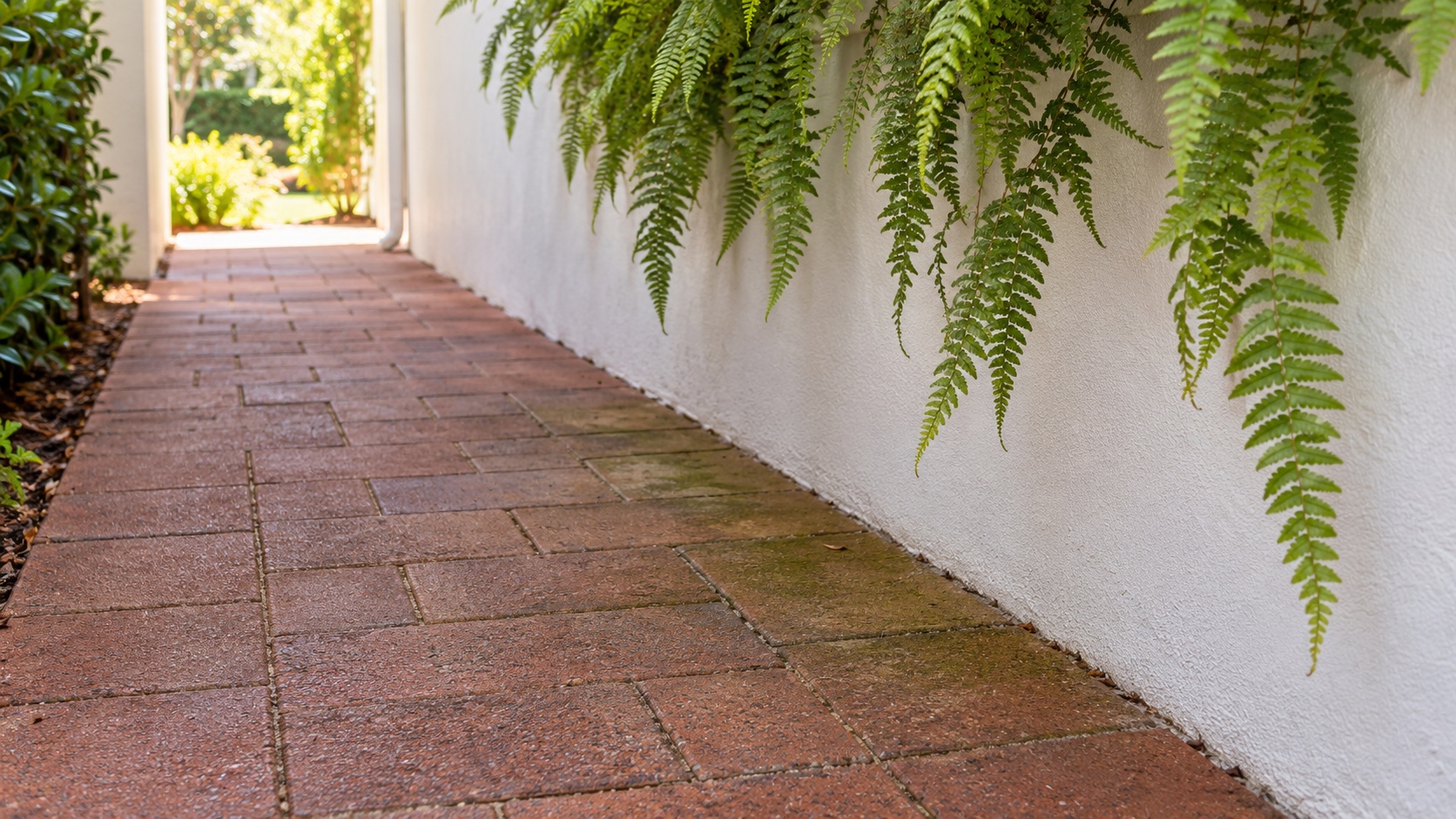
Green-looking patches on shaded pavers require assessment before you choose a cleaning scope. Color and photographs cannot establish the cause. Begin by recording where shade, wetness and debris occur, along with the paver material and any previous finish. Keep household access away from suspect areas. A professional can help decide whether the next step is cleaning, a separate site assessment or discussion of sealing. You do not need to commit to every service simply because the surface looks green.
For homeowners considering paver cleaning and sealing in Boynton Beach, the useful starting point is a description of the problem and how the area serves the household. A narrow side passage used for daily access needs a different work plan from an occasional garden sitting area.
AI-generated illustration of a shaded concrete paver passage. It depicts no completed project and provides no diagnostic evidence.
Build a record before the visit
Take an overall photograph from a safe position so the assessor can see the passage, surrounding walls and planting. Add closer views only where access is safe. Preserve the original images without color filters, and label each view by location. A photograph looking back toward the house can reveal context missing from a view toward the garden.
Keep a short observation log rather than trying to name the stain. Record:
- Where shade falls when you normally use the space, and whether the marked area extends into exposed sections.
- Where wetness remains compared with nearby pavers, and whether you observed rain or irrigation beforehand.
- Where leaves, flower litter or soil collect, including material caught beside walls or beneath hanging foliage.
- Whether the visible patch has changed since an earlier photograph, and what maintenance occurred between those views.
Write down what you actually saw. If you did not see a sprinkler reach the passage, leave that question open. A leafy edge, wet surface and green mark appearing together do not establish which condition caused another. Share observations with your landscape provider without asking for speculative changes before the site review.
Identify the surface and its history
Look for the original installation proposal, leftover product packaging or previous maintenance records. Give the assessor any known material name and finish information. If the previous owner arranged the work, mark that history as unknown. A description such as reddish pavers is useful for locating the area, but it does not identify the product.
Note whether the passage connects to stone steps, borders or another surface. Our guide to cleaning stone beside concrete pavers helps frame those transitions for discussion. The concrete guidance below does not authorize the same chemical treatment on natural stone; stone needs its own material and product review.
CMHA’s Cleaning, Sealing and Joint Sand Stabilization of Interlocking Concrete Pavement advises identifying stains, testing products and preparing concrete surfaces before sealing. Product compatibility requires specific review; results depend on the situation.
Ask what the professional’s trial will establish and how you will review it. Keep that approval separate from authorization for the whole area. Agree on what happens if the observed result leaves you uncomfortable proceeding, including who contacts you before the scope changes.
Make safe access part of the scope
Avoid using a suspect area when a safer route is available. Do not test traction by walking barefoot, deliberately sliding a shoe or rubbing the surface with your foot. Describe any difficulty already experienced during normal use and let the professional assess it. Color alone cannot establish whether a walking surface is safe.
Before scheduling, explain which doors, gates and household routes must remain usable. Include access for children, pets, deliveries and anyone with limited mobility. Ask how the work area will be separated, where equipment will enter and who will tell the household when access can resume. If the passage is the only practical route, resolve that conflict before booking work.
List belongings that need moving and identify who handles them. Point out delicate adjacent finishes, exterior outlets and items attached to the wall during the walkthrough. If access runs through an enclosed garden, agree on a route that leaves gates secure and keeps household traffic clear of the crew.
Choose the work that answers the finding
CMHA’s Operation and Maintenance Guide for Interlocking Concrete Pavement treats joint condition, movement and ponding as maintenance concerns beyond cosmetic cleaning. Sealer application follows cleaning.
Use the assessment to compare these possible scopes. They are choices to justify, not an automatic package.
| Possible scope | Question it should answer | Decision to record |
|---|---|---|
| Cleaning | What visible condition is the contractor proposing to address? | Define the work boundary and how you will review the appearance. |
| Separate repair or site assessment | Which contractor or specialist should assess the concern? | Name the responsible party and resolve dependencies before booking related work. |
| Sealing consideration | Does this finish suit your material and intended use? | Approve a specific proposal, defer it or leave it outside the current scope. |
For a passage with a small visible patch, ask whether the estimate covers that patch, the full walkway or adjoining sections. Have the contractor mark the boundary in a photograph or sketch. Compare proposals using the same boundary, and ask what additional work would require your approval. Otherwise, similar service names can describe different jobs.
To organize that conversation, request a consultation through our paver cleaning and sealing service. Send your location, photographs and known surface history. The next step is to arrange an assessment and discuss which work belongs in the proposal, which questions remain open and whether another specialist should be involved.
What a written scope can establish
An anonymous Boynton Beach natural-stone pool-deck written scope separately names cleaning, re-sanding and sealing. That record establishes the planned categories of work. It does not document completed work, a green-stain diagnosis or a cleaning outcome, and it supplies no project photograph for this article.
The useful purchasing lesson is the separation of tasks. Ask your estimator to distinguish what is included now, what remains conditional and what requires another decision. The presence of an item in that stone scope does not make it necessary for your passage. Nor does it make concrete maintenance directions suitable for the stone in that record.
Resolve the finish and the follow-up
Before choosing a finish, describe the appearance you want to retain. Bring attention to the view from adjoining rooms, the transition into brighter areas and your preference about sheen. Our guide to a paver sealer finish test offers a framework for that discussion. Do not accept algae-free or non-slip assurances as a substitute for assessing the actual surface and intended use.
Cleaning does not solve every recurring source. Drainage, irrigation or landscape concerns may require separate assessment. If a concern remains unresolved, have the proposal say so and name the next person to consult. The cleaning contractor should not be assumed to include changes to irrigation or planting simply because those features border the work area.
Set up a practical handover: keep the agreed scope, photographs and product information together, with the contact for follow-up questions. If green-looking areas reappear, record their location and circumstances again. There is no universal recurrence timetable to apply to every shaded passage, and another appearance change deserves review before you automatically repeat the previous work.
For your Boynton Beach property, request a paver cleaning and sealing consultation with the observation record and your access priorities. Ask to arrange an assessment, review the proposed work boundaries and identify any separate site questions. That gives you a defined next step and a scope you can evaluate before authorizing treatment.