Boynton Beach Pavers: Who Pays When the City Needs Access?
Planning driveway pavers in Boynton Beach? Understand owner restoration duties, the City's HHA guidance, and what to include in a future repair scope.
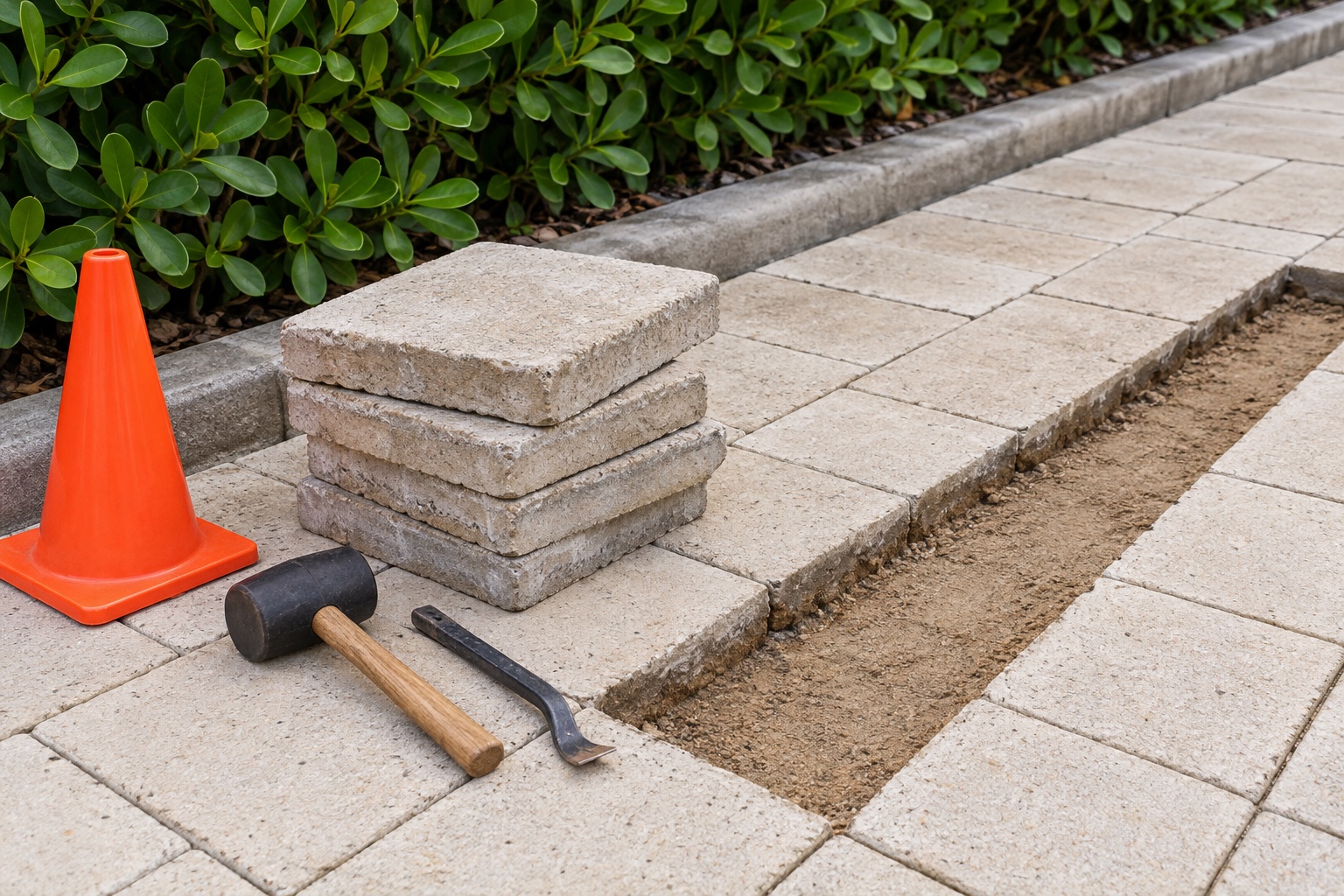
In Boynton Beach, the homeowner accepts full maintenance and reinstallation responsibility when the City allows pavers in its public right of way under a hold harmless agreement, or HHA. The Engineering Division FAQ says residents must remove pavers in time for City maintenance and/or replace them after construction. Budget for that possible return visit when choosing the driveway finish. Before signing, identify the area covered and read the agreement the City requires for your specific project.
When planning driveway pavers installation in Boynton Beach, include future access in the cost discussion before settling on materials. Even with the original pieces saved, someone needs to arrange the labor and supporting work required to put them back.
Where the driveway crosses into City right of way
A continuous driveway can cross boundaries that are invisible from the driver’s seat. Start with the property survey and proposed work limits. Have the City identify which portion falls within its public right of way, and establish the responsible jurisdiction for the address. A Boynton Beach mailing address alone is insufficient to determine which authority controls the street.
The Engineering FAQ requires a right-of-way permit for any work within the City’s right of way. Its HHA explanation addresses the resident’s maintenance and reinstallation responsibility when pavers occupy that space. Treat the permit requirements and the agreement as separate items to resolve with the City before work begins.
If the entrance geometry also needs attention, our guide to driveway flare requirements and turning room covers that subject. For future access, mark the area the City identifies on the driveway plan. You can then discuss which borders, pieces and adjoining features a removal could affect.
The published HHA is a Utilities form
The City’s published Hold Harmless Agreement identifies the Utilities Department in its return-to information. Its text addresses installation, maintenance, repair, removal and excavation involving utility equipment, lines or structures. The indemnity language is broad and includes legal, removal, excavation and replacement costs. It also states that when the City removes the described improvements for utility work on the property, restoration costs belong solely to the owner.
The form says it will be recorded in Palm Beach County’s Public Records and will encumber the described property, the owner, successors and assigns. It includes spaces describing the property and the improvements the City may need to remove. Read those descriptions alongside the cost language in the agreement presented for your project, and keep the completed document with the property’s records.
This Utilities document illustrates terms an owner may encounter. It does not establish that every driveway must use this exact form or that every HHA contains identical conditions. The Engineering FAQ explains the street right-of-way situation; the Utilities form addresses its stated utility-work scope. The City should identify the correct agreement for your project before you sign it.
Your attorney is the person to interpret the legal obligations and advise whether to sign. A contractor can discuss the physical work, access and restoration. Bring the property and improvement descriptions to that conversation so the proposed work can be compared with the area covered by the agreement.
Define what you want put back
The phrase “replace the pavers” leaves details unresolved. You may picture the same border, the same pattern and a smooth transition to the untouched driveway. A proposal needs to name those details so you can see what is included.
Before the initial installation, or before a known utility opening, write down the intended extent of restoration. Useful items include:
- The limits of the surface to be lifted, including borders and pieces cut around fixed features.
- Responsibility for lifting, storing and checking the condition of removed pavers.
- How the disturbed ground and supporting layers will be assessed before the surface returns.
- How missing or damaged pieces, joints, edge support and adjoining surfaces will be handled.
The removal area and the eventual repair area may need separate descriptions. After the utility work, the contractor can assess where sound construction remains and where rebuilding is needed. Allow for that assessment when requesting a restoration proposal.
Material selection, pattern and edge details belong in the original driveway pavers installation plan. For long-term ownership, include a conversation about how those details could be reinstated after an opening. Discuss spare material with the installer, including storage and identification. Its availability, condition and appearance will still need checking when a repair is planned.
Restoration includes the layers beneath the surface
CMHA’s Construction of Interlocking Concrete Pavements describes an assembly with prepared subgrade, compacted base, bedding, concrete pavers, joints and edge support. The visible units sit within that construction. Excavation can affect several of its parts.
Applying that construction guidance to restoration, the contractor should assess the disturbed assembly before quoting the finished surface. This is a practical recommendation for planning the repair, rather than a City restoration specification. The proposal can then separate work on supporting layers from reinstalling serviceable pieces and supplying replacements where needed.
Walk the edge of the proposed repair with the contractor. Point out where your recycling bin will roll from the untouched driveway onto the restored section, or where the border meets the curb. The wheels need to cross those joints smoothly. A close photograph of the existing transition helps explain the finish you expect.
Reusing pieces and matching the appearance deserve separate decisions. The condition of the removed units determines whether they are suitable to return. Where replacements are needed, inspect a sample beside the existing driveway in daylight. Agree how a visible difference will be handled before installation. The estimate should describe the intended treatment while leaving the reuse decision dependent on the condition of the pieces.
To discuss these choices for a new entrance, bring your survey, photographs and any City correspondence to our Boynton Beach driveway pavers team. Pavers of Palm Beach can review the driveway layout and affected features with you, then outline the construction work to include in a proposal. That gives you a specific area and set of details to compare with the City’s requirements.
Where a driveway meets a drain
Our concrete pavers driveway and drain project in Palm Beach Gardens shows a finished junction worth considering when defining reinstatement work. In the photograph, a dark linear drain crosses gray rectangular pavers, with the house on the left and a planted edge on the right.
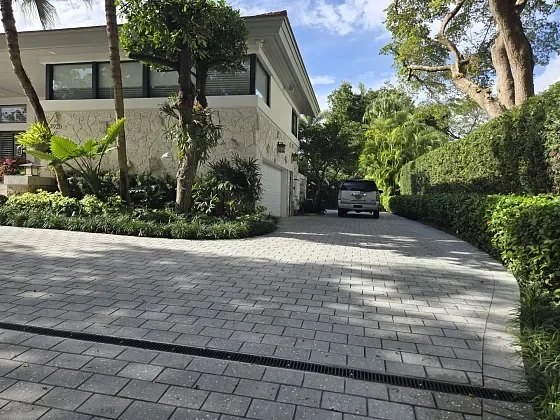
Project photograph from our Palm Beach Gardens portfolio. The documented work is a concrete pavers driveway with integrated drainage.
If a future opening reaches a fixed feature like this drain, the restoration proposal needs to address that junction. The surrounding pieces meet the drain along a visible line. The proposed repair should describe how the adjacent surface will be finished and how it will join the untouched pavers.
Keep a record someone can use later
Save the final plan, executed agreement, permit documents, material details and photographs together. Include clear views of borders, transitions and fixed features, plus a wider view that places them within the driveway. A close image of individual pieces is useful for material identification; a wider image helps locate where they belong.
If the City later needs access, take its notice and the existing records into the removal and restoration discussion. Establish who will coordinate removal, where pieces can be stored safely and when the City needs the area available. The City’s work requirements and the actual repair conditions will guide that conversation. Keep the agreed construction scope in writing so the work can be checked against it.
For your Boynton Beach property, contact Pavers of Palm Beach about driveway restoration planning with photos, your survey if available and the relevant City documents. The next step is to review the affected driveway area and discuss what a construction proposal should cover, including the supporting layers, surface and adjoining details. Bring the exact agreement into that process so its physical scope can be considered alongside the proposed work.