Utility Covers in a Paver Driveway: Plan Access Before Replacement
Replacing driveway pavers? Confirm utility cover ownership, vehicle use and finished levels, then define who handles adjustments and surrounding paver repairs.
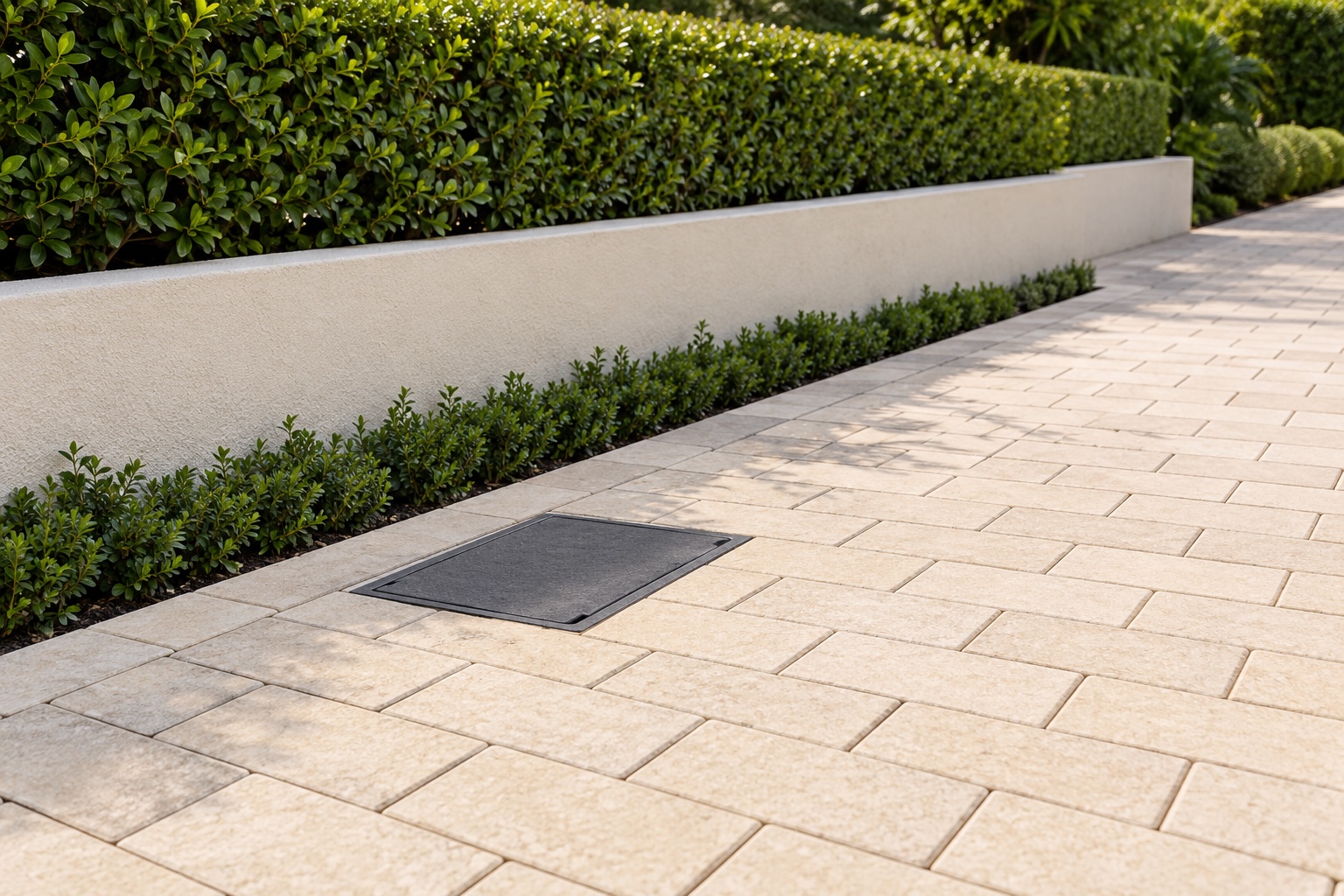
AI-generated illustration, not completed work or diagnostic proof. The cover and paver arrangement are illustrative, not an installation detail or approved layout.
Keep utility, meter and valve access in the driveway replacement brief from the start. Before approving the pattern or quote, identify who owns each cover and what it serves, record its visible condition, and have the utility owner or a qualified professional confirm access needs, vehicle-use suitability and the proposed finished level. The paver installer and equipment owner may have separate responsibilities. A neat surface does not establish that a cover is suitable for driveway use.
For homeowners considering driveway pavers in Palm Beach Gardens, include visible covers in the initial discussion. The same coordination questions apply throughout Palm Beach County, wherever driveway replacement meets existing equipment access.
Identify the cover before designing around it
Make a simple cover inventory from normal ground-level observation. Photograph the closed cover and a wider view showing its position relative to the driveway edge, wall or planting. Note visible markings without disturbing it, plus cracks, a damaged edge or a surface that appears higher or lower than neighboring pavers. Record observations, not diagnoses.
Then establish who can identify the equipment and confirm ownership. An old household note or an installer’s guess is a starting point for questions, not confirmation. A cover near the property boundary does not tell you who may change it. Leave covers closed and have identification or assessment that requires access handled by the responsible professional.
Keep each cover separate in your notes. If its owner or purpose remains unknown, mark that decision as unresolved rather than letting a driveway drawing assign it an assumed function. Share previous service records if you have them, without treating a past repair as approval for the replacement plan.
Confirm vehicle use and finished level together
A small plastic lid should not be assumed suitable for vehicles because cars have passed nearby for years. Describe how your household actually uses the driveway: parking, reversing, turning near the edge and occasional service access. Give that information to the utility owner or qualified professional evaluating the cover, its supporting parts and any proposed replacement.
Ask for the exact component identification and documentation supporting the proposed use. If replacement is suggested, confirm who selects and approves the parts. A matching color or familiar shape is not enough to establish that a substitute belongs on the existing equipment.
The proposed driveway finish also needs coordination. Have the professionals resolve the relationship between the cover, its frame and surrounding pavers before you approve the layout. Do not assume that raising or lowering nearby pavers authorizes an adjustment to utility equipment, or that the installer can relocate a cover to improve symmetry.
The driveway material needs its own review. Our porcelain driveway pavers product checklist addresses the selected surface and installation documents. Approval of those pavers does not establish the suitability of an adjacent cover or its supporting assembly.
Visible access is only part of excavation planning
A known cover does not identify every buried facility or its route. Coordinate the required locating before digging. Sunshine 811’s Homeowner: Every Dig Calls for 811 explains that it notifies member utilities; those utilities or their locators mark facilities. Sunshine 811 itself does not locate them. Put responsibility for that coordination in the project brief.
Keep the cover inventory and excavation planning together, but recognize their different purposes. Photographs help the team discuss visible equipment; they are not a subsurface survey. Avoid letting a clean driveway sketch create confidence about conditions nobody has verified.
Put the division of work in writing
The proposal should say who coordinates the work and who performs it. Those can be different parties. A driveway contractor can identify a dependency in the schedule without undertaking utility work, and a homeowner should not have to infer responsibility from a general promise to complete the driveway.
Use the written scope to settle these questions:
- Coordination: Who contacts the equipment owner, collects its response and tells the driveway installer when decisions are ready?
- Level adjustment: Who assesses whether adjustment is needed, who is authorized to perform it, and what must happen before surrounding pavers are installed?
- Product approval: Who confirms the existing or replacement cover and associated parts are suitable for the proposed use?
- Surrounding pavers: Who removes and restores affected units, and does that work fall within the driveway proposal or a separate agreement?
- Changes: Who documents an unexpected condition and obtains your agreement before additional work proceeds?
Our Palm Beach Gardens driveway service page describes a 2026 written scope for a porcelain driveway. That record does not document cover adjustments or utility work. If your proposal includes disposal and a new base, ask separately whether work around each existing cover is included and which tasks belong to another trade. Keep those answers alongside the driveway scope.
Request a consultation through our driveway pavers installation service with your closed-cover photos and any ownership information. Use the discussion to review the replacement area, identify unresolved coordination and request a written driveway scope that distinguishes surrounding pavers from equipment-owner work.
Review appearance after access is resolved
Once the equipment decisions are confirmed, review the pattern where it meets each cover. Ask the installer to show the intended surrounding cuts and explain how the layout preserves the access confirmed by the responsible professional. A drawing can help you judge appearance, but a paver grid is not an engineering plan or approval to modify equipment.
Consider the view from the street and from the usual walking approach. A deliberately arranged border may be more acceptable than a layout that tries to hide a cover. Make the aesthetic choice with the actual access conditions understood, rather than asking for concealment and discovering the conflict after installation.
For interlocking concrete pavers, CMHA’s Operation and Maintenance Guide for Interlocking Concrete Pavement discusses assessing condition and distress and removing and reinstating individual units for repair. It does not establish utility ownership or a cover’s rating. Its concrete-system repair guidance should not be transferred to porcelain.
Ask how future equipment service might affect the surrounding surface and who you would contact for restoration. Keep the selected paver identification and approved layout with your household records. Discuss spare material with the installer; matching a later repair should be a planning question, not an assumed outcome.
Keep access in the work sequence
Before materials arrive, have the team explain how equipment access will remain available through removal, preparation and installation. The driveway paver delivery planning guide helps organize unloading and storage, while the cover discussion identifies access those arrangements must respect. Have the professionals resolve conflicts before a storage location becomes part of the plan.
Ask what happens if the equipment owner’s decision is still pending when driveway work is due to start. Record which affected work must wait, who communicates that change and how the unfinished area will be managed. This gives you a practical basis for discussing the schedule without assuming every trade can arrive together.
Bring the open decisions to the consultation
Compare proposals by what they resolve. An excluded cover adjustment needs a named next step, while an included adjustment needs a clearly identified responsible party. Keep ownership confirmation, component approval, the agreed finish and surrounding restoration together so later conversations refer to the same decisions.
For a Palm Beach Gardens replacement, request a consultation about driveway pavers and replacement planning. Share your cover inventory, vehicle-use notes and unanswered questions. The next step is to review the driveway scope and identify which equipment-owner or qualified-professional decisions must be resolved before the pattern and quote are finalized.